Sunday, September 28, 2008

Heroes

Actor, and seriously cool blue-eyed mensch, Paul Newman, has died at the respectable age of 83. I could write for days on his brilliant, decades-long acting career, but instead want to acknowledge Newman the humanitarian, whose Newman's Own label of salad dressings and sauces earned around $250 million for charity. Wow!

For your viewing pleasure, here's the trailer for Exodus, one of Newman's best known roles.


I reviewed Exodus for a distributor of Jewish films.
Exodus
US, 1960, 208 minutes

Based on Leon Uris' sweeping novel, Otto Preminger’s star-studded epic tends to simplify and is arguably too long but as one of the few Hollywood films to tackle the creation of the State of Israel, Exodus is absolutely essential. Told from an admittedly pro-Zionist bias, the film relates the events that preceded the UN vote to approve partition of Palestine in 1948 through the exploits of Ari Ben Canaan, (Paul Newman) a member of the Israeli resistance group, Hagannah. Exodus is first and foremost a Hollywood adventure romance, but no other feature film captures the mainstream Jewish regard for the heroes of Israel’s birth. For more detail of the events of the film, check out the recently released documentary, In Search of Peace: Part One 1948 – 1967.

Monday, September 22, 2008

Wordplay

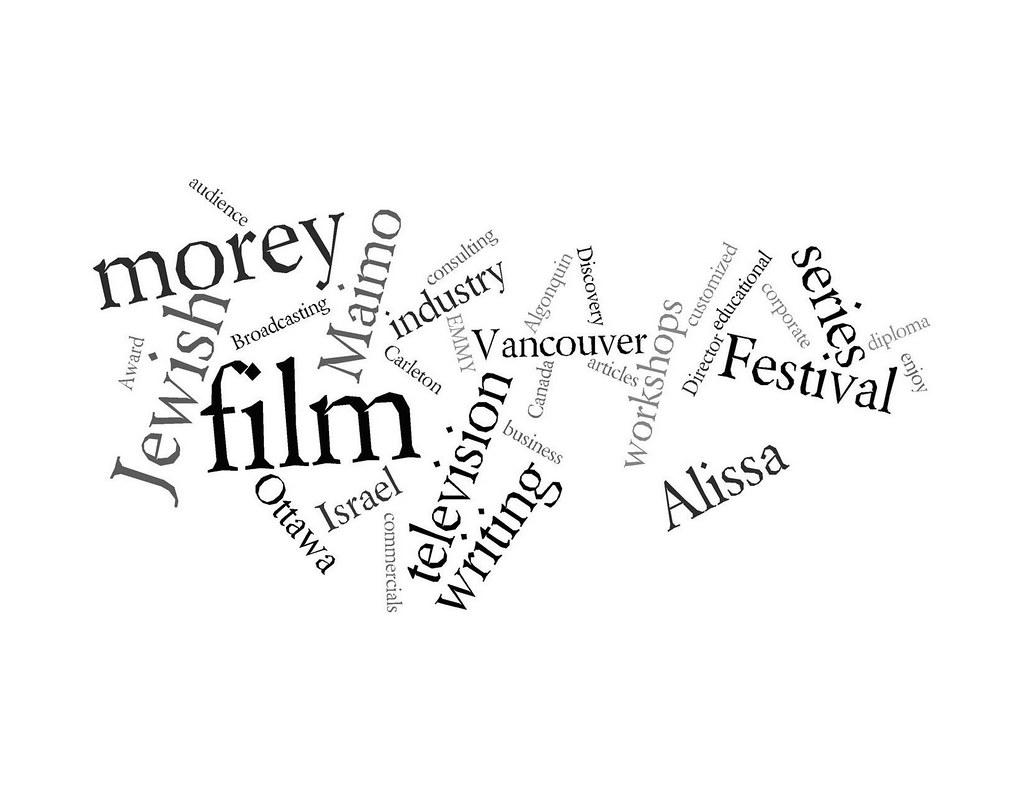
I have a problem. I'm a sucker for internet distractions. I've already shown you what I'd look like as a cartoon. Now (at last) I can reduce my bio to a Wordle, a representational 'word cloud' courtesy of IBM Engineer Jonathon Feinberg. Without further ado, Morey Altman reduced to 50 floating words:

Thursday, September 11, 2008

Machssomim*

We live near the Green Line and, because of the placement of Highway 443, pass through a checkpoint every time we go to Jerusalem. Checkpoints aren't all the same. This one controls entry onto a highway restricted to vehicles with Israeli licence plates. There are many who believe that these roads are, in fact, racist. Nothing could be further from the truth, as any of the Arab bus drivers who regularly take us to Jerusalem could tell you. But, these security measures are a necessity. Critics conveniently forget similar restrictions in other countries.

Case in point: the US response to the attack on September 11, 2001.

There were not only roadblocks set up around DC, all air traffic was rerouted away from the US, and even crossing the border by vehicle was temporarily stopped. It was only after many hours that traffic started to move again. I happened to be flying to the US two days later; the trip, which would normally take 4 hours, took 24 hours because of increased security. If the US was being attacked at the rate Israel has sustained shootings and bombings over the years, I would expect entry into America to be damn near impossible.

While real, these restrictions within and out of the territories are the direct result of terrorism. When Israel acquired the West Bank and Gaza, traffic to and from was relatively easy. I crossed the border in 1978 in minutes and there were no checkpoints anywhere. We visited Bethlehem, Jericho and Hebron and were welcomed (they wanted our tourist money, of course.)

And y'know, for all the bitching about the security fence (or whatever you want to call it), 10 years ago both Israelis AND Palestinians wanted more separation. A poll conducted in 1998 found 81 percent of the Israeli respondents and 63 percent of the Palestinians interviewed support(ed) a closed border. More importantly, both Israelis and Palestinians -- 77 percent and 65 percent, respectively -- said relations between the two peoples should be intensified in order to build support for peace. Ironically, one of the loudest opponents of a separation fence was Ariel Sharon, who was set against establishing any line that could be construed as a border.

Although living in Modi'in feels a little like being in the suburbs, we don't ever forget that we're also on the front lines.

*Checkpoint

crossposted to altmanaliyah.blogspot.com

Sunday, September 07, 2008

The Summer Exodus

As we approach the end of our annual reading of Deuteronomy, I can't help but be thankful for the relative ease of our exodus to the Promised Land compared to our ancestors: Seriously, Manna from heaven! 40 years in the desert! The Golden Calf!

But did it really happen like that?

I don't mean to sound facetious here. The Exodus, and unfortunate wanderings that followed, are easy to dismiss as brilliant 'storytelling' and nothing more. And within the recorded story, there are certainly elements that demand interpretation. The Torah was meant to be read and re-read by each generation; more importantly, it was meant to be relevant and inspirational. Sometimes, it's not the literal words that accomplish these things but the dynamic between the text and our experiences and ability to comprehend. One of the things I love is the Jewish custom of re-reading Torah portions every year.

It never ceases to amaze me how time and again, a passage I've read dozens of times can suddenly leap out at me with profound meaning and clarity. Did the words change? Did the story change? Not at all. I changed. I grew through study and gained new experiences as I've aged.

Torah interpretation also allows each generation to apply contemporary values and beliefs to the understanding of the texts. A good example of this is the phrase, "An eye for an eye." (Exodus 21) The rabbis of the Babylonian Talmud, recording oral tradition going back at least centuries, could not believe that the phrase was ever meant to be understood literally; the notion was abhorrent then and now. It was
clear that the text referred to monetary compensation because that understanding was consistent with their values.

Perhaps the understanding was different 3,500 years ago. Perhaps it will change in the future. Neither of which is as important as how the words are understood and applied to our lives today. Each generation is obligated to address the fundamental concerns and values of its time and to struggle with the parameters of necessary and permissible change. Deuteronomy itself insists upon this: we must rely on the judges/priests/leaders of our time "even if they say that right is left and left is right" (Sifre on Parashat Shoftim). And as we read in Parashat Nitzavim, "[Torah] is not in the heavens."

Did the Exodus really happen? Perhaps not exactly as described, but then the historicity of the Bible isn't as important as its relevance and meaning. The Bible isn't a history book, nor should it ever be reduced to such a mundane purpose. It's much deeper than that.

(crossposted to altmanaliyah.blogspot.com)

Thursday, May 01, 2008

Thou Shalt Remember

In April of 1942, Israel Altman, Freida (Frucht) Altman, Rosa Altman, Yonah and Breina (Altman) Rosenblatt, Yidel Rosenblatt, the parents and siblings of Hersch Weidman, Shaya Gelber, Yosel Gelber and their families were murdered in and around Rohatyn and Berezhany, Galicia. The wife and children of Jack Moraff were murdered in Belarus.

Zichronam l'Vracha. May Their Memories be a Blessing.

The 27th of Nissan is Yom HaShoah (Holocaust Remembrance Day), observed as a day of commemoration for the approximately six million Jews who were murdered in the Holocaust. In Israel, it is a national memorial day.

At 10:00am, air-raid sirens are sounded throughout the country for two minutes. People stand at attention on the streets; cars stop on the roads; for two minutes Israel is practically motionless.

This video is courtesy Jewlicious.

Thursday, April 24, 2008

Wrestling with God


I don't even like wrestling but I want this. It's just so davka, y'know?

You can order one for yourself here.

Thursday, April 17, 2008

Passover

What's my favourite thing about Passover, you ask?

Watching the Seda Club with Shabot 6000! Enjoy.


Dementia

What is President Carter thinking?

Hamas has failed since their first day in office to act as a responsible government both toward the citizens of Gaza and the international community. The first duty of an elected government is to honour and maintain (or renegotiate) agreements and treaties previously signed. Hamas refused to do so. Their response to a Presidential demand to lay down arms, cease rocket fire on Israel and work with the PA security apparatus was to 'take over' Gaza by ruthless force. Do you trust a 'democratically elected' government that throws political opponents off roofs, shoots enemies in the head in front of their children or coerces by shoving hoses down people throats and running water until their bodies explode? Hamas has long since lost the right to rule as a 'democratically elected' body.

Moreover, there's nothing to negotiate. The following is an excerpt from an interview with Hamas co-founder of Hamas, Mahmoud Al-Zahar:

"We do not and will not recognize a state called Israel. Israel has no right to any inch of Palestinian land. This is an important issue. Our position stems from our religious convictions. This is a holy land. It is not the property of the Palestinians or the Arabs. This land is the property of all Muslims in all parts of the world."

What does he see worth discussing?

Speaking with Hamas is not only an insult to Israel and world Jewry, which Hamas has threatened repeatedly, it is also a terrible disservice to the Palestinians, empowering the most intransigent elements in Palestinian society and implying that their President is impotent and wasting his time in direct negotiations with Israel.

Every time a terrorist organization is treated as anything other than a gang of thugs, which they are, they believe more strongly than ever that violence has earned them respect and international recognition. And they're right! As namby-pambies like Carter kiss their asses, Hamas simply continues its campaign of violence emboldened by the prestige it's achieved, thus only perpetuating the conflict.

And apparently even the PA agrees with me. Not sure if that's a good thing or not?

"Palestinian Authority officials urged visiting former US President Jimmy Carter on Tuesday not to meet with Hamas leader Khaled Mashaal in Damascus later this week. The officials expressed fear that Carter's planned talks with Mashaal would legitimize Hamas's violent takeover of the Gaza Strip and undermine the authority of PA President Mahmoud Abbas."

http://www.jpost.com/servlet/Satelli...cle%2FShowFull

And now the news that he wanted to meet with Islamic Jihad, but they turned him down (believing he's an agent of the US/Israel.) At least with Hamas, he had the excuse of saying they were an elected political body. What's his reasoning now? Wow, did I actually say REASONING?

Islamic Jihad: We Refused Carter’s Request for a Meeting

Eric Trager - 04.16.2008 - 3:52 PM Palestinian Islamic Jihad (PIJ) has announced that its leadership has refused former U.S. President Jimmy Carter’s request for a meeting. According to PIJ’s QudsNews website, Egyptian authorities contacted PIJ Secretary-General Dr. Ramadan Shallah on Carter’s behalf earlier this week, inviting Shallah to meet with Carter in Cairo. Shallah is listed on the FBI’s list of Most Wanted Terrorists, and the reward for information leading to his apprehension is $5 million. In turning down the request, Shallah declared that Carter is “carrying an American-Israeli agenda,” while PIJ spokesman Daoud Shahab blasted Carter’s criticism of Palestinian rocket attacks during the former president’s visit to Sderot. E-mails and phone calls to the Carter Center press office seeking confirmation of Carter’s outreach to PIJ have not been returned.

Friday, January 11, 2008

Made in America

There's been a lot of discussion lately about the US and to what extent it may be considered a Christian nation. Much of this debate has focused on America's constitution, which is notably lacking in references to God and the Christian church. But, as we more closely examine the issue, it's worth asking: which America are we talking about? The original settlements of the refuge seeking Puritans? The revolutionary America of the deist founding fathers? Traumatized America following the Civil War? The American melting pot of the 21st century?

The original settlers were unquestionably seeking religious freedom in the wake of insufferable repression under the English Church. But, there was much more to the Puritan mission than a desire for freedom: the Puritans saw themselves on a divine mission and they modeled themselves after the Hebrews of the Old Testament. "Come let us declare the word of the Lord in Zion," declared Puritan leader, William Bradford. America was to them the new Zion, and they set out to establish a new holy land under God's guidance. They cited Scripture as authority for many criminal statutes throughout the colonies and endeavoured (and generally failed) to convert the natives to Christianity. Christian writers of the period celebrated at length this "choice above all other lands." Cotton Mather, in his Magnalia Christi Americana extolled, "Christ's Great Deeds in America."

The New Land continued to attract both the persecuted and the rebellious. Within a few decades, the territories held Baptists of many varieties, Presbyterians, Quakers, and Puritans of all stripes, Anglicans, Roman Catholics, a handful of Jewish congregations, and undoubtedly those who described themselves as unaffiliated, many of whom were alienated if not hostile toward organized religion. Religious freedom in such an atmosphere became more than just a catchphrase; it was an absolute necessity in the face of such unique diversity and difference of opinion.

Increasingly many saw themselves as outside the Church. This was, in part, due to diversity of belief, but also the great distances between communities, and of course America's relative isolation from European religious leadership. The result was a religious revival known as the Great Awakening which swept over the American colonies from Maine to Georgia between 1730 and 1745. Theologian (and later President of Princeton) Jonathan Edwards, in 1742 wrote: "Tis not unlikely that this work of God’s Spirit, that is so extraordinary and wonderful, is the dawning, or, at least, a Prelude of that glorious Work of God, so often foretold in Scripture, which in the Progress and Issue of it, shall renew the World of Mankind ... And there are many Things that make it probable that this work will begin in America."

As he and others preached a return to the Church, a new manner of Christianity, neither Biblical nor European, emerged - an American Christianity. Americans bonded in a common understanding of Christian faith and being, and a fresh respect for lesser established denominations. The sentiment of John Wesley sums it up: "Dost thou love and fear God? It is enough! I give thee the right hand of fellowship." (The Complete idiot's Guide to Christianity, pg. 183)

It’s also worth remembering the role of religion in the American Revolution. While the conflict split some denominations, notably the Church of England (more than half of the Anglican priests in America, unable to reconcile their oaths of allegiance to the King with American independence, left their pulpits during the Revolutionary War), other theologians advocated that civil and religious freedom was ordained and therefore rebellion sanctioned by God.

It was incumbent upon the Founding Statesmen to recognize and acknowledge the vast range of religious opinion at the time. Still, this diversity was all seen within a Christian framework. "All the sects of the United States are comprised within the great unity of Christianity, and Christian morality is everywhere the same...Christianity, therefore, reigns without obstacle, by universal consent." (de Tocqueville, Alexis. Democracy in America, Vol. 1, Ch. 17.)True, they were all profoundly inspired by the lofty goals of Enlightenment. While several spoke against the more superstitious and incredulous aspects of Christian belief, there remained for most an essential faith. "I am a real Christian," wrote Thomas Jefferson, "that is to say, a disciple of the doctrines of Jesus." George Washington was an Episcopal vestryman; John Adams called himself "a church going animal." James Madison was a Hebrew major at Princeton. Most American statesmen seemed to share the convictions of their constituents that religion was, in the words of Alexis de Tocqueville, "indispensable to the maintenance of republican institutions."

It may well be that some were simply paying lip service to a religious constituency. Even so, they never failed to recognize the Christian nature of the land. If they held personal religious misgivings they felt no compunction against encouraging religious practice in others. Despite the absence of God in the Constitution, Congress appointed chaplains for itself and the armed forces, sponsored the publication of a Bible , recommended that all members of the armed forces “attend divine services”, and facilitated the promotion of Christianity to the natives. As well, National days of thanksgiving were established on which the American people could “express the grateful feelings of their hearts and consecrate themselves to the service of their divine benefactor" and on which they may” join the penitent confession of their manifold sins . . . that it may please God, through the merits of Jesus Christ, mercifully to forgive and blot them out of remembrance."

Over the years, Christian religiosity has continued to intrude itself into the American system despite the separation of Church and State. Following the American Civil War, for example, the words "In God We Trust" were added to US coins. And in 1870 Congress proclaimed Christmas a federal holiday.

I believe America is a Christian nation, even if most Americans today do not believe that Christianity should play a central role in governance, or that the United States itself should ever be regarded as a visible 'Kingdom of Christ on earth.' Surprisingly, I don’t have a problem with this. America has, through its Puritan antecedents and resolute founders, developed its own take on the divine mission, one that has sought to shake off the constraints of dogma and superstition in favour of Judeo-Christian practice, based on the rule of charity and respect of one's fellow. America is by no means perfect; the country has certainly experienced its share of anti-Semitism, although very rarely has it resulted in violence. Still, Americans continue to soul-search on these and other problems. Overall I think the Puritans would be pretty impressed with the freedoms their descendants and others now enjoy.

Thursday, June 07, 2007

B'Yerushalaim

During the 1948 war, Jordan captured approximately 2,000 sq. miles of Judea and Samaria west of the Jordan river, and the "Old City" of Jerusalem; 1,300 Jewish residents were expelled or taken to Jordan as prisoners. Jews living in West Bank and Gaza Strip were forced to flee the invading Arab armies. Kfar Etzion and other villages in the Jerusalem-Bethlehem corridor fell to Arab forces in May 1948 and those captured were massacred. For 19 years, Jews were denied access to the Wailing Wall.

The Israelis had been ordered to use small arms wherever possible to avoid damaging Holy places in the Old City. They were up against Jordan's Arab Legion, which had been formed and trained by the British under Glubb Pasha. The fighting was fierce, often hand-to-hand, and house to house. Jordanian mortars and shells continued to be fired into Jewish Jerusalem; snipers positioned in minarets, and behind churches rained bullets down on the Israelis as they made their way through the narrow, cobbled streets.

Slowly but surely, they pushed the Jordanians back until at last the Old City was back in Jewish hands. The destruction had been terrible; during the Jordanian occupation, the Arabs destroyed 58 Jerusalem Synagogues and systematically desecrated the ancient Jewish cemetery on the Mount of Olives. Soon, the repairs would begin; in a few weeks, Israel would remove the barbed wire and minesfields erected by the Jordanians that had divided the city since 1948; both Arabs and Jews would finally have free access to the city. Soon enough the city would be whole again. But, for a moment, time stood still.

Listen to CBS reporter, Michael Elkins report on the battle for Jerusalem here.

Listen to Israel Defense Forces entering the Old City of Jerusalem and reclaiming the Western Wall on June 7, 1967 (in Hebrew) here.

A transcript is available here. (bottom of the page)

The historic radio broadcast of the liberation of the Temple Mount and the Western Wall
was researched, transcribed and translated by Yitschak Horneman / Quality Translations, Jerusalem

Wednesday, June 06, 2007

Strike Zion!

Flying in fast and low to evade Egyptian radar, the Israeli Mirage III and Super-Mystère fighters struck at dawn. All but 12 Israeli jets, kept back to defend the home front, were utilized in the operation. Almost simultaneously, 11 Egyptian airfileds were attacked, destroying over 200 planes. Several hours later, after refueling, Israel struck again destroying another 100 planes. Enjoying near complete air superiority, Israel's tank battalions and infantry began to move across the Sinai and into the Golan Heights.

Upon the outbreak of hostilities on June 5, 1967, Israel had issued strict orders to her soldiers that there was to be no firing against the Jordanians. The Israeli government had secretly pleaded with King Hussein of Jordan, to keep out of the war; but, the plea was rebuffed by the Jordanian monarch. Fearful of losing his throne and perhaps even his life, he aligned himself with the Arab coalition and put his forces under Egyptian command. Even the Jordanian attack, Israel's PM, Levi Eshkol sent a message, through an intermediary: “If you don’t intervene, you will suffer no consequences.” When two hours passed without a reply, Israeli forces struck back at Jordanian positions.

After many hours of intense fighting against Jordan's well-trained Arab Legion, Israeli troops succeeded in taking control of the roads into Jerusalem. As the long day closed, they moved into the city. The Battle for Jerusalem had now begun.

Tuesday, June 05, 2007

Hot Enough for June

The war was, in many ways, inevitable. Neither Israel nor her Arab neighbours were satisfied with the outcome of the 1948 conflict. Israel had been left with borders that were difficult to defend, her citizens vulnerable to attacks from all sides. The Arabs had never supported the Partition Plan, and having failed to abort Israel at the outset, began planning for the day when they could eradicate the Jewish state.

Relations between Israel and Syria had been dismal for years. The two countries has sparred over control of water from the Jordan River, and Israel held the Ba’ath regime responsible for terrorist attacks perpetrated by militants operating from Syria.

Syria, anticipating an Israeli response to the border violations, signed a defence agreement with Egypt. According to the agreement, signed on 4 November 1966, an armed attack against either of the two signatories would be considered an armed attack against both. And, once war erupted, the Syrian and Egyptian armies were to operate jointly under the command of the Egyptian chief of staff.

In 1967, Egypt began to turn up the heat. On May 16, Egypt ordered UNEF troops to evacuate the Sinai region (U Thant agreed, without consulting either the UN General Assembly or Security Council, and much to Nasser's delight, also pulled troops out of Gaza). Thousands of Egyptian troops, 80,000 men and 600 tanks in less than three days, poured into the area and began to entrench themselves. Israel turned to both the US and the United Nations for assistance. Both suggested 'patience'; the Security Council was all but deadlocked by the Soviets and France. Fearing they were becoming politically isolated, Israel’s response was to begin to call up reserves--18,000 men on May 17, and an additional 17,000 the following day.

But it was Nasser's decision to close the Straits of Tiran that was the defining moment. Most countries, including the US, considered the closure to be a casus belli, an action tantamount to an Act of War. Israel required the Strait to reach Eilat, at the time it's most important port. And the Arabs also increased the vitriol of their rhetoric: Syria's Foreign Minister Ibrahim Makhous declared that “the withdrawal of the UN forces means ‘make way, our forces are on their way to battle.’” According to then-Defense Minister Hafez el-Assad, the Syrian army had “its finger on the trigger and demand[ed] that the battle be expedited.” 1.

Again, Israel pleaded with the US to intercede, but America was unwilling to challenge the Soviets, which were sponsoring the Arab states (and according to recent historical documents, had been lying to the Arabs telling them that Israel was preparing for war). 2.

Nevertheless, Nasser knew full well that closing the Straits would force Israel into war. After only a few weeks, Israel was running low on oil and food. Then France refused to honour previously signed agreements for planes and parts. Egypt continued the provocation: We are now’, Nasser declared, ‘on the verge of a confrontation with Israel’....‘If’, he added ominously, ‘the Jews threaten us war? I say to them “Welcome”, we are ready for war!'

With everyone still suggesting patience, time was running out. Both Egypt and Syria continued to amass troops and build defences. Israeli hospitals began to collect blood. Emergency morgues were prepared. Israel's military leaders now advised a preemptive strike: “Whoever waits for the Egyptians to start the war has got to know that we’ll lose the land of Israel!” Moshe Dayan declared, “It’s lunacy to wait!” The final straw was an intelligence report that Egypt was moving its army from a defensive to an offensive position, apparently with the intention of occupying Eilat.

After weeks of exhaustive efforts to forestall war, the Cabinet voted in favour of a preemptive strike. The attack would begin early the next morning, Monday, June 5.


1. Theodore Draper, Israel and World Politics: Roots of the Third Arab-Israeli War, p. 60.

2. http://meria.idc.ac.il/journal/2003/issue3/ginor.pdf

Monday, June 04, 2007

In the Days of War

In a few days, the world will mark the 40th anniversary of the 'Six-Day War.' To say that the Middle East is still dealing with the consequences of this conflict would be an understatement of Biblical proportions. Over the next few days I'm going to be (finally) updating my blog with thoughts and links on the war and its lasting effects.

It goes without saying, a number of groups around Vancouver will be marking the occasion in various ways. On Friday, June 1, Jews for a Just Peace screened BC filmmaker Jack Silberman's documentary, Raised to be a Hero.

Silberman's film may reflect a genuine opinion within Israel that the continued military presence in the disputed territories has been detrimental to both Jews and Arabs, but to suggest that the 'Refuseniks' represent a growing revolution, as some have done, is misleading at best. It may be true that 1,600 reservists have refused duty in Judea and Samaria (also known as the "West Bank" since Jordan's illegal annexation of the territory in the late '40's) and Gaza, but this number is a mere fraction of Israel's army. Almost all Israeli men do three years of mandatory military service. A mere 1,600 out of a standing army of around 445,000 - less than 1/3 of 1 percent - isn't much of a revolution. Contrast this with Russia, where an estimated 15 percent of those called up for military service illegally dodge the draft. If there's an ideological revolution worth mentioning, it's the realization that last year's disengagement from Gaza was a strategic and political mistake. In fact, far more 'refuseniks' refused to remove Jews from Gaza than have ever refused service in the territories. In an attempt (which failed) to forestall the evacuation of Gaza's Jewish residents, 10,000 soldiers signed a petition that declared "Jews don't deport Jews." The West Bank is even more complicated. There had been a perpetual Jewish presence there since Biblical times until the Jordanian occupation in 1948. Jordan expelled Jews from the West Bank and prohibited them from visiting religious sites. Since 1967, Jews have been able to return to the area. The settlements, regardless of their legal status, are problematic; but it has been Palestinian violence, since Yassir Arafat rejected peace negotiations and initiated the second intifada, that has demanded checkpoints, targeted killings and nighttime arrests. Indeed, as rockets continue to fly out of Gaza, one must wonder if disengagement from the West Bank, ostensibly the political demand of the 'refuseniks,' would really further the peace process. But, as I said, it's a complex issue. With any luck, the film will initiate dialogue but without due respect to the facts, constructive debate will be drowned by the rhetoric that tends to prevail.

Thursday, October 26, 2006

Comic Book Confidential

I've been busy on a few things including an article for Vancouver Jewish Independent. A recent visit to the Superheroes exhibit at the Jewish Museum in New York inspired me to do a profile of local comic-book artist Miriam Libicki.

You won't find caped crusaders or masked superheroes in any of Miriam Libicki's comic books.

Her self-produced comic, Jobnik!, chronicles her day-to-day life in the Israeli army in frank, often blunt terms. Jobnik is Israeli slang for someone in the army with a desk job. More of a graphic diary than a comic, Jobnik! imparts a rarely seen perspective of an army generally viewed as vigilant and relentless. Jobnik! takes us behind the scenes, where soldiers wash dishes, file reports and fool around.

You can read the whole article here.

Thursday, September 28, 2006

A New Year

There is a modern midrash that goes:

Step down, step down. Watch a heel crush, crush.
Uh oh, this means no fear - cavalier.
Renegade and steer clear!
A tournament, a tournament, a tournament of lies.
Offer me solutions, offer me alternatives
and I decline.

It's the end of the world as we know it.
It's the end of the world as we know it and I feel fine.


That was of course, Rabbi Michael Stipe from Congregation R.E.M.

I was reminded of this song while considering the Unetane Tokef, the moving piyyut or liturgical poem that we read each Rosh Hashanah and Yom Kippur. The Unetane Tokef was supposedly written by Rabbi Amnon of Mainz in the tenth or eleventh century, but is actually many centuries older; portions of the Unetane Tokef appear in a very ancient Genizah fragment from the late eighth century, 200-300 years before Rabbi Amnon was supposed to have composed the poem! And many scholars now believe the document was written in Palestine during the Byzantine occupation, and not in Europe at all.

But, regardless of when and where it was composed, the Unetane Tokef is one of the most powerful texts in Judaism. It is also a difficult work. It is here that we are reminded of the fact that on Rosh Hashana, judgement is inscribed, and on Yom Kippur, it is sealed: "who shall live and who shall die." The prayer even mentions the ways in which death will come: water, fire, sword, beast, and earthquake, and plague. These images are no idle threats; the Torah is filled with similar horrors.

Speaking of the end of the world, Jewish history is replete with endings that should have been final. We've done more final tours than the Rolling Stones. From our exile from paradise to our exile from Eretz Yisroel; from the destruction of the Temple to the destruction of European Jewry, it is no understatement to say if we were not here, if the Jewish people had ceased to exist centuries ago, there is not an archaeologist or historian alive who would be the least bit surprised.

But here we are.

So why the emphasis on mortality? "Who shall live and who shall die? Who shall be at peace and who shall be tormented, who shall be poor and who shall be rich, who shall be humbled and who shall be exalted?" Do we really need so many reminders that our lives are fragile and short?

And what do we make of a line like: "repentance, prayer and tzedakah avert the severe decree" when we know this isn't true. Every day a righteous, beautiful life ends - and there's no shortage of those who have perished at the hands of evil tormentors, despite the prayers and a life of charity. What gives?

There is a saying from the Pirke Avot that illuminates this passage, "All is foreseen, yet free will is given." We may not be able to control the numbers of our days, but we can control how we live. We can choose to be gracious and generous, kind and hopeful, even in the face of great danger and imminent destruction. And I'd like to think we as a people have done exactly that. We have always persevered in spirit. The truth is, we all die.

But as Mr. Spock so aptly put it in Star Trek VI, The Undiscovered Country: "I've been dead before." It always comes as a surprise when I tell non-Jews that the Jewish people believe in reincarnation and the return to earth of the Neshama. But it's not a subject we dwell on. It is THIS life that is important.

Today, we mark the birthday of mankind. We are reminded throughout the Jewish year of the passage of time. Each week is celebrated on Shabbat; each month is celebrated on Rosh Chodesh; but Rosh Hashanah is a little different. It is not the year we celebrate, but our own lives. We do not reflect on the events of the year, but the events of our days. And we consider how we might have improved them. In fact, through this process of evaluation, repentance and renewal, we are given a special gift. The ability to reinvent ourselves!

I'm reminded of a Dear Abby column from many years ago. A woman wrote, "I am 44 years old and have always wanted to be a doctor. Until now, my life circumstances didn't permit it, but if I try to get to medical school, I won't be a doctor for at least six years and by then I will be 50. What should I do?"

And Abby replied, "In six years you will be 50 anyway. You might as well be a 50-year-old doctor and fulfill your dream."

I was listening to that R.E.M. song many years ago in the car with my father. He wasn't that hot on pop music, but he liked the chorus of the song. Every moment, he said, is the end of the world as we know it. Every year, our lives change in ways we could never imagine. And it's all good, he said.

Today IS the end of the world as we know it, and I feel fine.

Monday, August 21, 2006

Have I Got News for You

I'm not much of a journalist. Not in the Matthew Halton sense, anyway. I'm far more comfortable pontificating from my ergonomic chair than documenting truth from a seedy hotel room on the other side of the world. But I hold my colleagues in the highest regard. Despite some recent allegations from the blogging world of photo-tampering, and even an admission from Reuters that a few photos had been photoshopped by a Lebanese photographer named Adnan Hajj, the industry as a whole cannot be condemned. Reuters uses hundreds of photographers and processes thousands of images every week. To their credit, they immediately admitted the problem, and are looking into ways to prevent this from happening again. The admission of error was an acknowledgement that the system isn't perfect, but improvable. I'm not sure if we could ask for more. Frankly, I'm more concerned about agencies like AP that won't even admit the possibility that some photographers take advantage of their craft to promote a personal agenda, let alone acknowledge media bias at the editorial level.

A number of websites continue to examine and discuss media manipulation by Hezbollah (and others) during the recent war in Lebanon. EU Referendum was one of the first to suggest that photos and video taken in Qana after an Israeli attack had been stage-managed. I watched some of the video available:


Having worked in the television industry for 20 years, I have no doubt that a so-called rescue worker is 'directing' the scene. His hand signals to the camera operator are unmistakable. That's not to insinuate that there were no victims of the attack. But this violation of truth, and others, have left me understandably cynical. I should say, more cynical. When I first graduated, I spent a week as camera assistant with a major Canadian broadcaster. I was disturbed to see the camera operator manipulate objects in view during interviews, or ignore certain images that may recast the story the wished to present. I'd like to think this isn't the norm, but I know it happens.

Still, I'm confident most journalists endeavour to maintain integrity and objectivity, even if a few are corrupt. It's also worth noting that every year, dozens of journalists pay the ultimate price to keep us informed. In 2005, 65 reporters and photo-journalists were slain for the crime of seeking truth. Twenty-five journalists have already been killed this year. Although some have died in combat zones, the vast majority were murdered by agents of a repressive government. This is, of course, one of the most insidious peculiarities of news gathering: it's simply impossible to report from exactly those places where the news is most compelling. In terms of Israel, there are probably more reporters per square foot than anywhere in the world. It's a beautiful, safe country that enjoys and respects freedom of the press. Sadly, the same can't be said of its neighbours. This was especially evident last month, with even mainstream journalists admitting they were compromised by Hezbollah restrictions and threats. But, then 'Truth' has always been subjective. "Everything we hear is an opinion, not a fact. Everything we see is a perspective, not the truth." (Marcus Aurelius, 121-180 CE)

Wednesday, August 16, 2006

Cease Fire!

I haven't commented up until now on Israel's war against Hezbollah, but not for want of an opinion. Now that there is a CeasefireTM, here are a few thoughts.

Every conflict has both military and political objectives. The military goal - disarming Hezbollah - was practically impossible and, despite accusations that the war effort has failed, most Israelis must have understood this. The best case scenario was to destroy as many rockets and launchers as possible before a cease-fire was imposed by the United Nations. Although it appears little has been achieved despite loss of life numbering in the many hundreds, I think, at this time, it's impossible to know the long-term benefits of this conflict. There are many that believe the conflict will only fuel more terrorism; I don't believe this is true.

Lebanon's sectarian population has always been split, with Christians and Druze generally supporting Israel's efforts to remove militant forces (thousands of Christians actually fled to Israel in 2000 fearing a rise in militant Islam in the south, and possible retribution against Christians who supported Israel after 1982). Shiite Moslems have generally supported or condoned both the PLO and Hezbollah because they see these groups as armies in a larger conflict: Pan-Arabism (until 1982) and Global Jihad (after 1982). I don't believe this current conflict will increase support, and its likely that many Lebanese, of all stripes, will blame Hezbollah for their recklessness (even if they hold Israel responsible for the deaths.) The Arab street traditionally display public support for its leaders and their military exploits, even when privately they may be critical. It's quite possible that Hezbollah will now lose some of the political support they've enjoyed, and their seats in parliament. We'll know with the next election.

Although chemical and/or nuclear weapons weren't used this time, an enemy poised with thousands of rockets along an un-supervised border is unacceptable. Moreover, Hezbollah serves as a de facto army of Iran, which has spent many years and millions (billions?) of dollars arming the group as part of a coalition of forces to be used against Israel. With many of those rockets now used or destroyed, and Israeli (and soon International) forces now establishing a buffer zone between Israel and Lebanon, a front in a future war has been removed. In that context, this effort may prevent a massive three-pronged strike by Iran, Syria and Hezbollah. Israel's enemies must now consider that any attack on Israel risks involving the international community.

Additionally, some of the political goals, which were far more realistic, have been achieved - at least in writing. UN Security Council Resolution 1701, passed unanimously last week, clearly states that the war and resulting deaths are blamed on Hezbollah attacking Israel, as well as declaring that the unconditional release of Israel's soldiers is mandatory. Israel is also not obligated to remove any troops until an international force is in place, nor do they have to release any Lebanese prisoners; the Resolution simply says that the issue of the three Lebanese prisoners is to be "settled." No demands on Israel at all. The resolution also acknowledges the Shebaa Farms dispute but again makes no demands on Israel. And it's in Israel's best interests that the UN now focuses on Iran: the real instigator of so much of this violence. Over the next few months, expect both the US and Israel to continue their war of words against Iran. Israel will need to have the sympathy of both the General Assembly and the Security Council; defying a UN brokered cease-fire now could have unacceptable negative long-term consequences.

It's also worth noting the unprecedented initial condemnation of Hezbollah from a few Arab countries. Even now, Egypt is warning terrorist groups in Gaza and Lebanon to consider the cost-benefit ratio of entering into a conflict with Israel. If these groups cannot depend on the financial support of Arab states, moderate forces may finally be able to speak up. And some Lebanese politicians are publicly rebuking Syria's Bashar Assad who has been suggesting that anti-Syrian elements in Lebanon are "collaborating with Israel." These events, in themselves, indicate significant changes in the status quo.

Any parent or fan of Supernanny will tell you that altering a child's bedtime routine takes a little time. You can't expect much to happen on the first night. Maybe a little crying on the second night. Hopefully, on the third night - success! Israel cannot expect to overnight change the behaviour of those in the Arab world who support terrorism. But this conflict sent a message that the status quo has changed. Hezbollah believed Israel would accept a prisoner exchange because they had done so in the past. That expectation no longer holds true.

Of course, the likelihood is that the conflict is not going to end anytime soon. Hezbollah will find an excuse to launch rockets again, and Israel will exercise its right to responds to attacks. Hezbollah will also certainly refuse to hand over the kidnapped soldiers to the Red Cross or anyone else. Moreover, the international force itself may become the target of Hezbollah attacks (remember the Marine barracks bombing?) potentially igniting an even larger conflict. In the minds of many, it made more sense to let the IDF finish the job it started, but it was the politicians - who recognize that not all battles take place on the battlefield - and not the generals who made the final decision. In the grand scheme of things, that's how we all want it. For better or worse.

Wednesday, May 31, 2006

Clueless

In a move sadly reminiscent of Orwellian doublethink - blacklists are free speech - the National Association of Teachers in Further and Higher Education (NATFHE), the largest university and college lecturers' union in Britain, has now passed a motion boycotting their Israeli counterparts who refuse to condemn Israel's 'occupation' of so-called Palestinian lands. Apparently, free and open thought is not the imperative of academia after all. Maybe it's just me but isn't punishing academics for the policies of their government a little like blaming the hippies for the Vietnam War?

Speaking of groupthink, this current rash of dysfunctional group behaviour from the British Left is in no way a new phenomenon. Some have suggested that very old anti-Semitism is to blame.1 I’m reluctant to over-simplify the discussion. There are other factors worth considering.

Anti-globalists amongst the British Left are certainly playing a part in this round of anti-Israel activity. They claim to decry all forms of imperialism, but in practice have spent an inordinate effort targeting the Jewish state. Israel's economic success, especially compared to the backward economies of her neighbours, is seen to be a result of her collusion with the globalist forces (i.e. The US of A). As Mark Strauss, a senior editor for Foreign Policy writes (it's a pay link, sorry), "Islamists and secular nationalists alike portray globalization as the latest in a series of US-Zionist plots to subjugate the Arab world."

Ironically, it is the British who were the Imperialists not so long ago. In pre-state Palestine, the Leftists readily identified the Jew as a legitimate enemy based on perceived collusion with the British during the Mandate years.2

Is there legitimate concern that British antipathy towards Jews is real? In January 2002, British left-wing magazine The New Statesman published a cover story on the "Zionist lobby" in Britain. The cover displayed a golden Star of David stabbing a Union Jack behind the banner: "A Kosher Conspiracy?" To be fair, the magazine's editor apologized (after many complaints) but it's hard to dismiss such a blatant expression of distrust.

At the very least, this current spate of anti-Zionism is acerbated by a blithe ignorance of 2,000 years of Jewish nationalism (not to mention erstwhile British support for Zionism). What is more mystifying is the apparent lack of knowledge of contemporary Middle East history. Considering the role of the British themselves, their sense of historicity seems illusory at best.

Some are suggesting that a boycott of British academics is now warranted. I can’t go along with that. But I do know I’ve lost a lot of respect for these allegedly learned men and women. If their judgement can be so impaired by bias, and their research so willingly absent, can their academic output really be trusted?

But all of this is beside the point. Members of NATFHE may well have real and sincere complaints to make against the Israeli government on behalf of Palestinian Arabs. However, NATFHE is not a political body. It is an educational union. And the issue at hand is academic freedom.

Despite petitions and emails to forestall the boycott vote on the grounds it would impinge academic freedom, NATFHE approved the resolution recommending that its 67,000 members personally boycott all Israeli professors, lecturers, universities and colleges, unless they publicly forswear Israel's "apartheid policies" in the territories. Paul Mackney, NATFHE's secretary-general, will likely feature in a future course on irony.

Mackney, an unabashed supporter of Palestinian rights,3 has said: "Palestinian civil society, including the universities, needs support and solidarity as never before, and I will not be bullied into silence."

Good for you, Paul. God forbid your opinion should be stifled.

  1. As described in an essay by Ben Cohen: The Persistence of Anti-Semitism on the British Left.

  2. “[Resolved: that] the revolt of the oppressed peoples in the colonies against imperialism has always been accompanied by destructive attacks against the national minorities when they aided the imperialist regime, and that the revolt of the Arab masses in Palestine against the imperialists had been and would in the future be accompanied by a war of annihilation against the Jewish minority, as long as it cooperated with the British imperialists. - Palestine Communist Party resolution, 7th Congress, 1932
    (Zachary Lockman, “The Left in Israel: Zionism vs. Socialism,” MERIP Reports, July 1976, p8)

  3. Seen here addressing a Palestine Solidarity Campaign conference (Shabbat, March 1, 2003)


Update

It should be noted that on June 1, 2006 NATFHE will join the Association of University Teachers (AUT) to form the University and College Union (UCU).

Today, AUT issued the following statement:

"AUT does not endorse this policy and is strongly advising its members not to implement it." The full statement can be read here.

In May 2005 the AUT council overwhelmingly rejected an earlier decision to boycott two Israeli universities and reasserted its belief that freedom of expression, open debate and unhampered dialogue are prerequisites of academic freedom. They also established a commission to investigate the effectiveness of boycotts. The report of that commission was passed this month by AUT. It recommends that boycotts are applied only in exceptional circumstances, are fully justified by the facts, and can be shown to be an effective way of furthering academic freedom and human rights.

It's impossible that Paul Mackney and NAFTHE were unaware of AUT's position regarding boycotts of Israel. Ergo, NAFTHE's resolution (and subsequent vote) was a calculated publicity stunt (albeit with some symbolic value). Perhaps their efforts to improve the lives of the Palestinians would be more effective if they worked to make real change rather than play at politics like students pretending to be diplomats at a model UN.

Saturday, May 20, 2006

Deliver Us From Evil

Great article by Bradley Burston over at Ha'aretz: "Why 'Jews for Jesus' is evil"

My comments as posted to the article:
Without getting into an argument over who is 'right' and who is 'wrong,' I must completely agree with Bradley Burston on this one. No one is suggesting that groups like 'Jews for Jesus' have no right to their beliefs; of course they do, even if we think they're misguided. The issue is intrusive practices like targeting Jewish homes for door-to-door canvassing or scattering Christian propaganda pamphlets near Jewish schools. If the cause is so righteous, are these abhorrent practices necessary? Shouldn't the cause sell itself? Jesus may have been truthful, but his followers have used every nefarious trick in the book to substantiate their faith.

Which brings us back to the real problem: it is the existence of Jews that is an affront to (revelationist) Christians. As long as we exist, there will be doubt in their minds as to the truth of their beliefs. In the end (and it's truly the end we're speaking of), they care only for our souls to save their own.

Wednesday, May 10, 2006

Blood Was Flowing Like a River

What do we really mean when we say "never again"?

Since the expression came into vogue after the Holocaust, the world has experienced countless genocides, from northern Congo to Cambodia’s killing fields to the Rwandan massacres. We can't seem to stop the killing. Worse, we don't seem to care. Indifference, the real culprit as Elie Wiesel has pointed out, is pervasive and systemic. But what is at the root of it?

Sadly, I fear that it is not so much aloofness as racism that drives this apathy. We are afflcited with the worst kind of prejudice: that which forgives the actions of a group because "they can't help it;" that which condescends to allow immoral behaviour because presumably not everyone can be expected to live up to the white man's morality.

Across Africa, thousands have suffered - murdered, raped, deliberately starved - with barely a blip in the world press. As the conflict continues to claim victims in the Sudan, we change the channel and turn the page. I hate to ask an uncomfortable question, but what is the source of your indifference?

Moreover, I think that for too long, we've made the mistake of allowing "never again" to hover over us like a hypothetical ideal for future age. If "never again" is to have any meaning, it must be reinvented as a call to arms. We must make "never again" mean "not now." And it must apply universally.

See my sidebar for links to information pages, petitions, emails and educational handouts on Darfur and what you can do right now.